Bengaluru: Karnataka has now placed all its evidence on E20 petrol before the Government of India, in a detailed letter that goes beyond politics and puts the common man at the centre of the fuel debate.
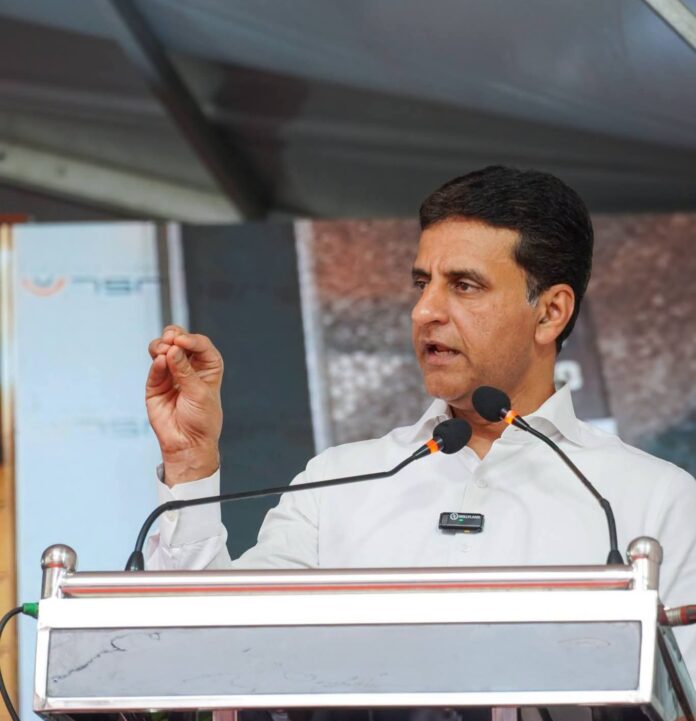
Minister for Food, Civil Supplies, Consumer Affairs and Legal Metrology, Rizwan Arshad, has written to Union Minister for Petroleum and Natural Gas, Hardeep Singh Puri, on the subject – Karnataka’s Fuel Test Findings and Steps to Protect the Common Man.
The letter begins with a clear clarification. The Government of Karnataka is not against the Ethanol Blending Programme but against over-blending. The programme cannot come at the cost of the citizens. A transition of this scale needs the whole ecosystem to be ready, including fuel infrastructure and ethanol-compliant vehicles, and that transition takes time.
Over the past several months, the Government of Karnataka has received a very large number of complaints from motorists across the State. People have reported falling mileage, rough running of engines, damage to older vehicles, and receiving less fuel than they paid for. When so many ordinary citizens raise the same concern, no government can afford to look away. Left unanswered, such complaints turn into a trust deficit between the people and the fuel sold to them. The State therefore undertook the responsibility to verify, through officers empowered under law, both the quality and the quantity of petrol sold to the people of Karnataka.
On the question of quality, the letter refers to the Ministry of Petroleum and Natural Gas Notification S.O. 860(E) dated 17th February 2026, in force from 1st April 2026, which directs oil companies to sell ethanol-blended motor spirit with ethanol content of 20 per cent as per BIS specifications. Clauses 7 and 8 of the Motor Spirit and High Speed Diesel (Regulation of Supply, Distribution and Prevention of Malpractices) Order, 2005 empower officers of the State to inspect retail outlets and draw samples to check compliance.
In September 2026, State officers inspected 63 retail outlets across districts, covering outlets of IOCL, BPCL, HPCL and MRPL. As a first step, and in good faith, the samples were sent through the OMCs’ State Level Coordinator to the designated laboratories of the three public sector OMCs. Of the 63 samples, only 42 reports have been received so far, and not one of them reports the percentage of ethanol content in the sample.
When the Government of Karnataka asked why, it was told that the Research Octane Number is the parameter for compliance. However, the OMCs’ own reply acknowledges that IS 17021 mandates measurement of ethanol content in blended petrol, yet no such measurement has been carried out. This, the letter says, is a clear admission of non-compliance with the very standard they cite. A report that is silent on ethanol therefore cannot certify compliance with an E20 mandate. Moreover, the reports for the remaining 21 samples are yet to be received, and no reason has been given for this inordinate delay.
The Government of Karnataka was therefore not satisfied with these results. Fresh samples were drawn and sent to independent laboratories accredited by NABL, India’s own national accreditation body. Of the 14 samples tested, 11 were found to contain more than 20 per cent ethanol, with the highest at over 31 per cent.
The OMCs have since sought to contest these findings, alleging that the samples were not collected as per the prescribed procedure and questioning their density. The State rejects these allegations in their entirety as baseless and factually incorrect. Every sample was drawn by officers duly authorised under the 2005 Order, strictly in accordance with the procedure laid down in clause 8, with counterpart samples sealed and handed over on the spot. The density of each sample was recorded in the prescribed proforma at the point of collection and signed by the dealers and other authorised representatives, and the densities reported by the laboratories match those recorded at the outlets. To keep the process credible, the State Government did not use its own laboratories and instead had the samples tested at NABL-accredited laboratories.
The letter says the OMCs kept back the one fact consumers needed to know, and they are now trying to discredit independent, accredited findings instead of answering them. This is not a technical objection. It is an attempt to avoid accountability, and it goes entirely against the interests of the common man.
Two further findings deserve attention. First, the blend is not uniform. Ethanol content across the samples ranged from 13.5 per cent to 31.2 per cent. The notification prescribes a blend of 20 per cent. A variation of this magnitude clearly indicates non-compliance by the OMCs. Such wide variations leave the consumer wholly unaware of the composition of the fuel being dispensed. Every consumer has an inalienable right to know the exact composition of the fuel for which he or she pays. Second, premium high-speed petrol, which consumers buy at nearly 120 to 140 rupees per litre precisely because it is marketed as a superior fuel, was also found to carry a high percentage of ethanol. The common man, practically, is left with no real option.
The State’s inspections have also created a clear sense of deterrence and there are indications that the blend may since have been corrected. However, consumer protection cannot rest on the hope that one round of inspections has set matters right. Karnataka will therefore continue to check fuel quality at retail outlets on a continuous basis.
On quantity, the concern extends beyond what is in the fuel to how much of it they actually receive. Two recent notifications of the Central Government have weakened the safeguards. Notification G.S.R. 905(E) dated 18th December 2025 doubles the mandatory verification interval for petrol and diesel dispensers from 12 months to 24 months. Notification G.S.R. 346(E) dated 8th May 2026 amends the rules governing Government Approved Test Centres, so that private test centres can verify dispensers, a function so far performed by government inspectors.
Before adopting these changes, the State’s Department of Legal Metrology carried out a state-wide inspection survey, the first such study by any State. Of the 5,946 retail outlets in Karnataka, 805 were inspected, and 768, nearly nine in every ten, required recalibration. Of the 3,071 nozzles tested, 2,618 showed deviation. A total of 101 outlets were found dispensing beyond the maximum permissible error and were booked, with fines of 6.66 lakh rupees collected. Most significantly, even nozzles found within the permissible limit were nearing their tolerance threshold within just 9 to 11 months of use.
These findings show that the existing annual cycle is itself barely adequate. A 24-month cycle would leave a large share of dispensers delivering short measures long before their next check. The State has therefore decided not to implement either notification and will continue annual verification through government inspectors. It has also written to Union Minister of Consumer Affairs Pralhad Joshi, seeking reconsideration of both notifications.
In the final part, the Minister makes five demands for consideration. One, display of the actual blend at every pump. Two, ethanol percentage on every bill. Three, choice of lower-blend fuel, E10 and ethanol-free petrol along with E20 at affordable costs until the fleet is fully compatible. Four, an independent testing mechanism using NABL-accredited laboratories, with every report stating ethanol content. Five, an E20 compensation fund to compensate consumers whose vehicles suffer damage from petrol with ethanol above the prescribed limit.
The letter concludes that the E20 policy, as implemented today, requires urgent course correction. It can succeed only if the common man is placed at its centre, not made to bear its cost. Karnataka has placed all its evidence before the Government of India and would welcome a detailed discussion at the earliest, so that together we can protect the people and restore public trust.