
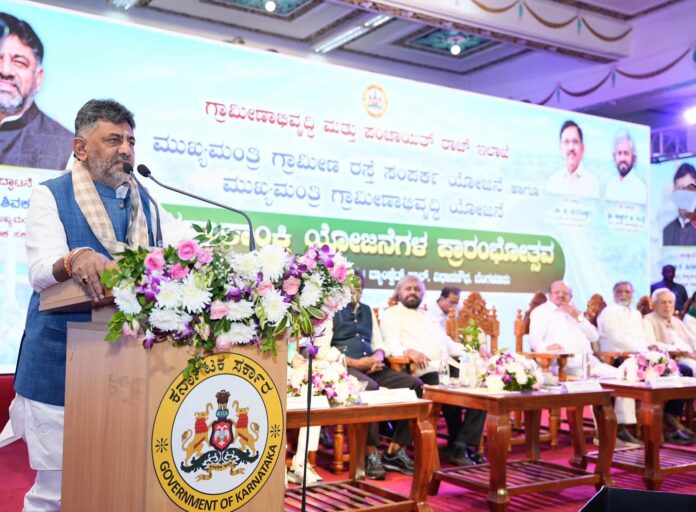
Bangaluru: In a major initiative aimed at fulfilling the dream of owning a house for poor families, the Karnataka government has decided to increase the minimum size of residential sites distributed to economically weaker sections from 20×30 feet to 30×40 feet. The decision was announced by Chief Minister D.K. Shivakumar, who said the move would enable poor families to construct better houses in the future and prevent the emergence of new slum areas.
Speaking after inaugurating the Chief Minister’s Rural Road Connectivity Scheme and Chief Minister’s Rural Development Scheme at the Banquet Hall of Vidhana Soudha on Friday, Shivakumar said the Cabinet had approved the decision to provide larger residential plots to eligible beneficiaries.
He explained that the earlier 20×30 feet sites were often insufficient as families grew and required additional space. To ensure that children from economically weaker families could also build decent houses in the future, the government had decided to provide sites measuring at least 30×40 feet.
The Chief Minister said the government was even prepared to reduce the number of sites, if necessary, to ensure that beneficiaries received larger plots. He also instructed officials to give priority to families that did not own houses or residential sites. Those who already possessed houses or plots should not be given the benefit again.Announcing a major investment in rural infrastructure, Shivakumar said the government had earmarked ₹16,000 crore to transform villages across Karnataka.Of the total allocation, ₹10,000 crore would be spent on developing approximately 15,000 kilometres of rural roads under the Chief Minister’s Rural Road Connectivity Scheme. The remaining ₹6,000 crore would be utilised for development works at the gram panchayat level, including drainage, drinking water facilities and other essential infrastructure.
He emphasised that the funds were intended to improve the living conditions of rural people and not to benefit contractors. He directed officials to ensure that every rupee was properly utilised and that transparency and quality were maintained in all development works.Under the road development programme, projects will include resurfacing existing roads, improving gravel roads and constructing drainage facilities. Depending on the nature of the work, the estimated expenditure will range from ₹38 lakh to ₹70 lakh per kilometre. He also recalled that ₹5,000 crore had already been allocated under the Pragati Path scheme.
The Chief Minister issued strict instructions to officials to prevent corruption and irregularities. Every project must be documented through photographs and videos before work begins and after its completion. The exact geographical coordinates of project locations must also be recorded.
He made it clear that no development work should be undertaken without following the proper tender process. Project progress will be monitored through the Chief Minister’s dashboard. WhatsApp groups must also be created at panchayat and district levels to share details and updates about ongoing works.Expressing concern over complaints of unnecessary road repairs, submission of bills without executing works and misuse of public funds through collusion between contractors and officials, Shivakumar warned that such practices would not be tolerated.
The government has set an ambitious target of distributing 15 lakh residential sites to eligible beneficiaries across Karnataka. In the first phase, five lakh sites will be distributed, for which approximately 9,000 acres of land have been identified. The government will also assess the expenditure required to develop essential infrastructure such as roads and drainage facilities.
Highlighting the importance of rural development, Shivakumar said nearly 47 per cent of the population had already shifted from rural areas to cities, and experts had projected that the figure could rise to 76 per cent in the coming years.He said rural people, particularly the children of farmers, were migrating to cities in search of better employment, education and living conditions. This trend could be reversed only by creating adequate opportunities within villages.
The Chief Minister urged officials and gram panchayats to encourage industries and businesses in rural areas without creating unnecessary administrative hurdles for entrepreneurs. Special development policies were also being implemented for coastal and Malnad regions.
Recalling Mahatma Gandhi’s vision that India’s soul lives in its villages, Shivakumar said the development of Karnataka depended on the progress of rural areas. He urged officials to consider the ₹16,000-crore allocation as an opportunity to transform rural livelihoods and ensure that basic facilities, housing, drinking water, healthcare, education and employment opportunities reached every village.