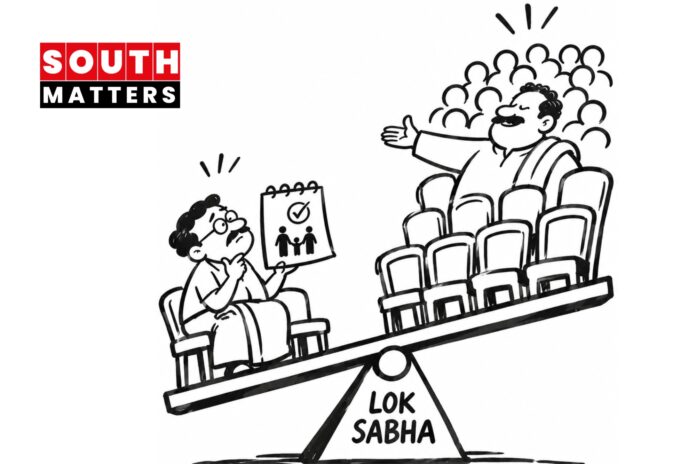
Tamil Nadu 59, Karnataka 42, Andhra Pradesh 38, Keralam 30, Telangana 26. These are the Lok Sabha seat numbers the Union government has put out for the South, yet the Delimitation Bill 2026 as introduced in the Lok Sabha does not contain a single state-wise number, a formula or a written guarantee. With reports of a special Parliament session in December, that gap between what is promised and what is written decides how loudly your state will speak in Delhi for the next few decades.
The Big Picture
Delimitation means redrawing constituencies and re-dividing seats among states according to population. India has not re-divided Lok Sabha seats among states for about five decades. The Statement of Objects and Reasons attached to the Bill, signed by Law Minister Arjun Ram Meghwal on 11 April 2026, says the present division of seats among states still rests on the 1971 Census, and constituency boundaries on the 2001 Census.
In April 2026 the Centre brought three linked bills: the Constitution (131st Amendment) Bill, the Delimitation Bill and a bill on Union Territories. According to reports by Newslaundry, Outlook and PTI, the amendment would raise the maximum size of the Lok Sabha to 850 seats from the current 543 elected seats. The package is also tied to the one-third reservation for women passed in 2023, which can start only after a fresh delimitation.
What the Numbers Say
There are two very different sets of numbers in circulation, and most of the argument comes from mixing them up.
The Centre’s version: every state grows by 50%. Figures attributed to the Union Home Ministry, reported by Oneindia in April 2026, add roughly half to each state’s present strength in a House of 816. PTI reported the same 39-to-59 figure for Tamil Nadu in August 2026.
The feared version: seats strictly by population. Projections by The Hindu, cited by Newslaundry in April 2026, show what happens if an 850-seat House is divided purely on 2011 Census population:
- Uttar Pradesh: 80 seats to 138, share rising from 14.73% to 16.24%
- Bihar: 40 seats to 72, share rising from 7.37% to 8.47%
- Maharashtra: 48 seats to 78
- Tamil Nadu: 39 seats to 50, share falling from 7.18% to 5.88%
- Keralam: 20 seats to 23, share falling from 3.68% to 2.7%
- Southern region overall: share falling from about 24% to 20.7%
Put simply, under the first method Tamil Nadu gets 59 MPs; under the second it gets 50. Keralam gets 30 or 23. Nobody loses seats in absolute terms in either case, because the House itself becomes bigger. What changes is each state’s share of the total, and that share is what counts when Parliament votes.
What the Delimitation Bill 2026 Actually Says
The text of Bill No. 108 of 2026, available on the PRS Legislative Research website, sets up a three-member Delimitation Commission: a serving or former Supreme Court judge as chairperson, the Chief Election Commissioner or a nominee, and the State Election Commissioner of the state concerned. Each state also gets ten associate members, five MPs and five MLAs, who cannot vote on its decisions.
The Commission’s job is to readjust seats among states on the basis of the “latest census figures”. The Bill names no census year, gives no total number of seats, lays down no formula and carries no clause saying a state’s share will be protected. It does provide for reserving as nearly as possible one-third of seats for women, by rotation.
This is why the Opposition asked in Parliament where the 50% promise is written. The Wire reported on 16 April 2026 that Home Minister Amit Shah answered that he was saying so as the minister who piloted the bills. Shah also told the Lok Sabha, as reported by Oneindia, that no state in the South would see its representation reduced.
How We Got Here
A constitutional amendment needs two-thirds of the members present and voting. In the special sitting in April, the amendment got 298 votes in favour and 230 against, when 352 were needed, according to The Tribune, which dated the vote to 17 April. The South First reported the same 298 and 352 figures. The government fell short by 54 votes.
Since then the ground has shifted. PTI reported on 12 November that the government plans a special session and that its sources expect to win by 15 to 18 votes, with 361 votes needed in a House that has three vacancies. The same report said a fresh draft is understood to keep the existing ratios between states, based on the 1971 Census, along with the 50% rise. No session dates have been announced.
The South First, citing The New Indian Express, reported on 19 November that the Centre has reached out to the DMK with an assurance that the latest population data would not be used. DMK MP Kanimozhi said on 18 November: “We do not know what the new Bill will contain.”
Where Each Side Stands
- Union government: every state gains seats, the South keeps close to 24% of the House, and women’s reservation cannot begin without delimitation.
- DMK: according to Oneindia in August 2026, it wants the freeze on seat shares extended by 25 years and the 50% rise for all states put in writing. Party leader R S Bharathi said it would decide only after seeing the bill.
- Tamil Nadu government: Chief Minister Vijay wants the 543-seat total and state-wise shares frozen permanently and asked the state’s MPs in August to oppose the Bill, Outlook reported.
- The wider southern worry: even with the same percentage, a verbal assurance can be changed by a later government unless it is written into the Constitution.
What It Means for You
More MPs means smaller constituencies. If the 50% plan goes through, your Lok Sabha constituency will almost certainly be redrawn, and your MP will represent fewer voters than today. Your Assembly constituency may change too, since the Bill requires every Assembly seat to fall fully inside one Lok Sabha seat.
For women candidates the arithmetic is direct. The Tribune, quoting a Union minister in June 2026, said one-third reservation on Tamil Nadu’s present 39 seats would reserve 13 and leave 26 open, while 59 seats would mean 20 reserved and 39 open.
A state’s share of Parliament also shapes its bargaining power on central funds, tax sharing and national laws. The difference between the two tables above, about three percentage points of the House for the South, is the size of that stake.
What Happens Next
Watch for three things: the date of the special session, the text of the fresh draft, and whether the 50% rule and the freeze on state shares appear in the bill itself rather than in speeches. Even after Parliament passes the package, the Commission must publish draft proposals, hear objections and hold public sittings before final orders. Under the Bill, new boundaries apply only to elections held after those orders are notified.
Quick Questions
Will southern states lose Lok Sabha seats after delimitation?
No state loses seats in absolute numbers under either projection. Under the Centre’s 50% plan the South’s share stays near 24%; under a pure 2011 population formula it would fall to 20.7%, according to The Hindu’s projections cited by Newslaundry.
How many Lok Sabha seats will Tamil Nadu get?
59 under the government’s stated 50% plan, up from 39. A population-only formula on 2011 data would give it 50.
Has the Delimitation Bill been passed?
No. The linked constitutional amendment was defeated in the Lok Sabha in April 2026. The government is reported to be planning a special session to bring a fresh version.
Key Takeaways
- The Centre says all states get 50% more Lok Sabha seats: Tamil Nadu 59, Karnataka 42, Andhra Pradesh 38, Keralam 30, Telangana 26.
- The Delimitation Bill as introduced in April contains no seat numbers, formula or guarantee.
- A pure population formula on 2011 data would cut the South’s share from about 24% to 20.7%.
- The first attempt failed 298 to 230 in April; a special session is now reported to be planned.
- The real test is whether the promise is written into the law.
Would a written 50% guarantee be enough for your state, or should seat shares be frozen for another 25 years? Tell us in the comments.