
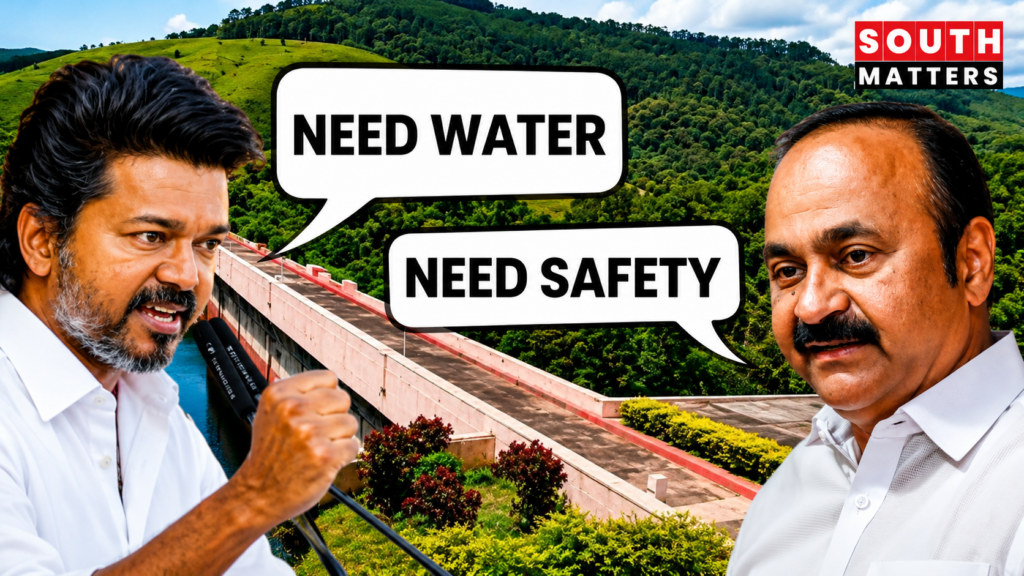
The Mullaperiyar Dam issue has once again become a major political and public debate after Tamil Nadu Chief Minister Vijay rejected Kerala’s demand for a new dam. The issue is not simply a dispute between two states. It is a complex question involving water security, public safety, history, law, and the livelihoods of millions of people.
Tamil Nadu argues that the dam is essential for its farmers and drinking water needs. Kerala argues that the 130-year-old structure poses a potential safety threat to people living downstream. Both concerns are real, and both deserve attention.
The History of Mullaperiyar Dam
The Mullaperiyar Dam was built in 1895 across the Periyar River in what is now Kerala’s Idukki district. The project was designed during British rule to divert water from the west-flowing Periyar River to the dry regions of present-day Tamil Nadu.
At the time, large parts of southern Tamil Nadu suffered from frequent droughts and water shortages. British engineers believed that redirecting Periyar water could transform agriculture and improve the lives of thousands of farmers.
The project eventually became one of the most important irrigation schemes in South India.
How Tamil Nadu Got Rights Over the Dam
The roots of the dispute go back to 1886, when the Maharaja of Travancore signed a lease agreement with the British-controlled Madras Presidency.
Under the agreement, around 8,000 acres of land were leased for 999 years. The British government was allowed to build, operate, and maintain the dam and divert water to the Madras Presidency.
The dam was completed in 1895, and water began flowing to the dry districts of Tamil Nadu through a network of tunnels and canals.
After Independence, Kerala inherited ownership of the land where the dam is located, while Tamil Nadu retained operational rights under the agreement. In 1970, both states signed a revised agreement that reaffirmed Tamil Nadu’s rights to operate the dam and use its waters.
For Tamil Nadu, Mullaperiyar is not merely a dam inside another state. It is a lifeline built through a legally recognized arrangement that has supported generations of farmers for more than a century.
Why Mullaperiyar Matters to Tamil Nadu
Today, the dam supplies water to several districts including Theni, Madurai, Dindigul, Sivaganga, and Ramanathapuram.
Millions of people depend on this water for agriculture and drinking purposes. Farmers grow paddy, sugarcane, vegetables, and other crops using Mullaperiyar water.
Any reduction in water storage or disruption to the water supply could have serious economic consequences for southern Tamil Nadu. This is why Tamil Nadu strongly opposes any move that could weaken its water rights.
Chief Minister Vijay has argued that Tamil Nadu cannot compromise on a water source that has sustained its people for generations.
Why Kerala Wants a New Dam
Kerala’s concern is centered on safety.
The Mullaperiyar Dam is more than 130 years old and was constructed using lime-surkhi masonry, a technology from the nineteenth century. Kerala argues that no matter how many strengthening measures have been carried out, the age of the structure remains a concern. The state fears that extreme rainfall, earthquakes, or structural deterioration could pose risks to people living downstream. Kerala’s position is that a new dam should be built while ensuring Tamil Nadu continues to receive the same amount of water. The state says its demand is not about denying water to Tamil Nadu but about ensuring the safety of its people.
What Happens If the Dam Collapses?
This is the most sensitive part of the debate.
Many expert committees and court-appointed panels have concluded that the dam is structurally safe after strengthening works. Tamil Nadu often points to these findings to support its position.
However, Kerala argues that long-term safety concerns cannot be ignored because of the dam’s age.
If a catastrophic collapse were ever to occur, the consequences could be severe.
A massive flood wave could rush through downstream regions of Idukki district. Thousands of homes, roads, bridges, businesses, and public facilities could be affected. People living in vulnerable areas could face enormous danger.
Even though experts disagree on the level of risk, the fear of such a scenario remains a major concern for Kerala.
What Have the Courts Said?
The Mullaperiyar issue has reached the Supreme Court multiple times.
Court-appointed expert panels have generally concluded that the dam is safe after strengthening measures and that water levels can be maintained within approved limits.
These rulings have largely supported Tamil Nadu’s position regarding dam operations.
However, Kerala continues to maintain that long-term safety concerns require a permanent solution.
As a result, the legal and political debate continues.
Water Versus Safety Is the Wrong Question
The Mullaperiyar issue is often presented as a choice between Tamil Nadu and Kerala. But that is the wrong way to view it. Tamil Nadu needs water. Kerala needs safety. Neither demand is unreasonable.
Farmers in Tamil Nadu cannot afford to lose a water source that has sustained their lands for over a century. At the same time, families living downstream in Kerala cannot be expected to ignore concerns about safety. The challenge is not choosing one state over another. The challenge is finding a solution that protects both livelihoods and lives.
The Way Forward
The Mullaperiyar dispute should not become a political battle between neighbors. Tamil Nadu and Kerala share deep cultural, economic, and social ties. The issue deserves a solution based on science, engineering, transparency, and mutual trust.
Whether that solution involves further strengthening of the existing dam, a new structure with guaranteed water rights, or another engineering alternative, the goal should remain the same.
Protect Tamil Nadu’s water. Protect Kerala’s people. Because in the end, this is not a fight between water and safety. Tamil Nadu needs water. Kerala needs safety. India must find a way to protect both.