
By South Matters Space Desk | Space & Science
NASA has officially unveiled the crew for the highly anticipated Artemis III Mission, a crucial step in the United States’ long-term plan to return humans to the Moon.
The mission, scheduled for launch before the end of 2027, will serve as a key preparation flight for future lunar landings and deep-space exploration.
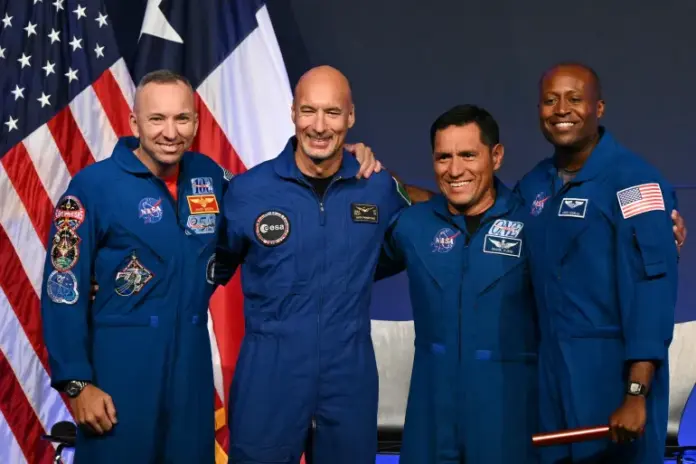
NASA announced that astronauts Andre Douglas, Frank Rubio, Luca Parmitano, and Randy Bresnik will form the primary crew, while veteran test pilot Bob Heintz will serve as the backup astronaut.
The announcement marks another milestone in the Artemis program, which aims to establish a sustained human presence on the Moon and eventually support missions to Mars.
Meet the Artemis III Crew
The four-member crew brings together extensive experience from military aviation, medicine, engineering, and previous space missions.
Randy Bresnik will command the mission. The former Marine and NASA veteran previously commanded the International Space Station and participated in a Space Shuttle mission.
Luca Parmitano, a veteran astronaut from the European Space Agency, will serve as pilot. He previously became the first Italian commander of the International Space Station.
Frank Rubio joins as mission specialist after setting the record for the longest single-duration spaceflight by a U.S. astronaut at 371 days.
Andre Douglas, an engineer and former Artemis backup crew member, will make his first trip to space as mission specialist.
Mission Focus: Preparing for Future Moon Landings
Unlike earlier expectations, Artemis III will not directly land astronauts on the Moon.
Instead, the mission will focus on testing critical technologies and procedures that future lunar missions will require.
The crew will spend approximately two weeks in space conducting docking exercises involving lunar lander systems developed by Blue Origin and SpaceX.
These operations will help NASA validate procedures necessary for future Moon landings.
Public-Private Partnership in Space
The Artemis III Mission highlights NASA’s growing collaboration with private aerospace companies.
SpaceX and Blue Origin will both play major roles in the mission by providing lunar lander test vehicles.
NASA officials describe this approach as essential for reducing costs, accelerating innovation, and expanding America’s capabilities in deep-space exploration.
The mission also reflects increasing international cooperation, with the European Space Agency participating through astronaut Luca Parmitano.
Questions Over Blue Origin Setback
The announcement comes shortly after a recent explosion involving Blue Origin’s New Glenn rocket during testing.
The incident raised concerns about readiness for future Artemis-related missions.
However, NASA officials and Blue Origin executives have expressed confidence that the setback will not affect Artemis III timelines.
Both organizations say technical investigations are underway and corrective measures are already being implemented.
Space Race With China Intensifies
The Artemis program is unfolding against the backdrop of growing competition in space exploration.
China has announced plans to land astronauts on the Moon by 2030 and continues expanding its lunar research capabilities.
NASA officials view Artemis as a critical effort to maintain American leadership in space exploration.
Several U.S. policymakers have also highlighted the strategic importance of establishing a long-term presence on the lunar surface before rival programs achieve similar goals.
The Road to the Moon Continues
The Artemis III Mission represents another major step toward humanity’s return to the Moon.
NASA sees the mission as a foundation for future lunar landings, permanent lunar infrastructure, and eventual crewed missions to Mars.
While technical challenges remain, the newly announced crew now carries the responsibility of preparing the next generation of lunar explorers.
For NASA, Artemis III is not the final destination. It is the next chapter in a much larger journey beyond Earth.