Political Analysis desk | South Matters | Chennai
There was a time when the Indian Political Action Committee, popularly known as IPAC was spoken of in the same breath as electoral invincibility. The organisation that helped Narendra Modi storm to power in 2014, delivered Jagan Mohan Reddy a historic mandate in 2019, and kept Mamata Banerjee in Kolkata’s Writers’ Building against enormous odds in 2021, was considered the gold standard of Indian political consulting. That reputation now lies in ruins.
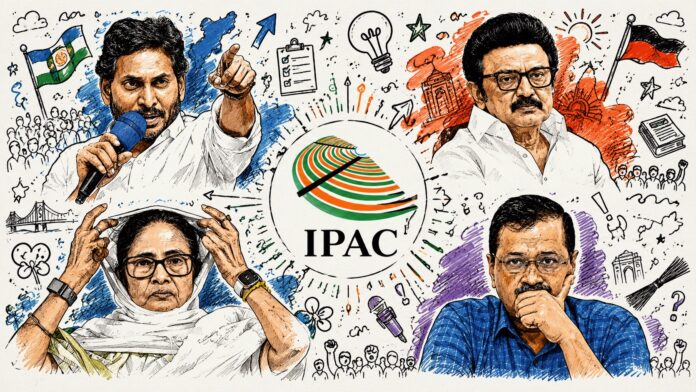
Between 2024 and 2026, IPAC operating without its founding brain Prashant Kishor and under the stewardship of Rishi Raj Singh has overseen four consecutive high-profile defeats that have collectively shattered whatever credibility the firm still carried into this decade. The YSRCP in Andhra Pradesh, AAP in Delhi, the DMK in Tamil Nadu, and the Trinamool Congress in West Bengal, four different parties, four different states, four catastrophic losses. The common thread running through all of them is IPAC.
The Fall Begins: Andhra Pradesh 2024
The Andhra debacle of 2024 is where the post-Kishor IPAC story truly begins to unravel. IPAC, led by Rishi Raj Singh, played spoilsport with the chances of the YSRCP led by YS Jagan Mohan Reddy in the 2024 Andhra Pradesh assembly elections.  The scale of the collapse was staggering. Jagan was so badly misinformed by IPAC that he went to their office after the counting and said he will win more than 151 seats in 2024. In reality, YSRCP won just 11 seats. 
That single image, a sitting Chief Minister walking into his consultant’s war room on counting day to celebrate a victory that was, in fact, one of the worst defeats in state electoral history, captures everything that went wrong with IPAC in Andhra Pradesh.
The YSRCP suffered a heavy defeat, following which criticisms emerged over alleged flawed surveys, aggressive social media strategies, and distancing of leadership from Jagan Mohan Reddy. For years, concerns had been raised internally. Jagan Mohan Reddy looks to have been entirely duped by IPAC by the presentation of fabricated reports. The difference between 2019 and 2024 was stark: in 2019, political strategist Prashant Kishor personally kept tabs on IPAC. He had assembled a potent group of specialists, analysts, and field personnel, conducted a thorough examination of the political climate in Andhra Pradesh, and personally developed the YSRC’s manifesto and welfare agenda. That rigour was simply absent the second time around.
While Robbin Sharma-led ShowTime Consulting ran a campaign focused on the people and the hardships they faced in recent years, IPAC’s campaign was centred around Jagan, it ultimately turned out to be Jagan versus Andhra. The TDP-led alliance won 164 of 175 seats. After much hesitation, Jagan finally severed all ties with IPAC following its failure to help the party regain power.
Rishi Raj Singh: The Man Who Inherited a Legacy He Couldn’t Sustain
Understanding IPAC’s downfall requires understanding the man at its helm. Rishi Raj Singh hails from Uttar Pradesh and is an alumnus of IIT Kanpur. He worked with HSBC and Credit Suisse before becoming one of the founding members of Citizens for Accountable Governance (CAG) in 2013 along with Prashant Kishor.
After Kishor snapped ties with IPAC and started focusing on his political career in Bihar, his former aide Rishi Raj Singh began helming the poll consulting firm. The transition seemed logical on paper, Singh had been part of every major IPAC campaign and understood the organisation’s DNA. But running IPAC and being Prashant Kishor were two fundamentally different things.
After taking over IPAC from Prashant Kishor, Rishi Raj Singh and his team failed in most of the states where they offered their services, including Trinamool Congress in Goa and the Aam Aadmi Party in Haryana.  These were not obscure contests. Each failure was a warning sign that went unheeded by client parties who were too invested in IPAC’s past reputation to notice the organisation’s present inadequacy.
The pattern of misleading clients also came under scrutiny beyond Andhra. An IPAC strategist regularly presented reports and survey findings, claiming they reflected ground-level political realities. In the 2024 elections, the YSRCP suffered a massive defeat, and none of the strategist’s predictions matched the actual outcome. The same source reveals a telling anecdote: when Jagan later asked the strategist how many seats TVK would win in Tamil Nadu, the strategist predicted only around 30 to 35 seats. After the results were declared, TVK went on to win 107 seats, completely disproving the prediction. By this point, even Jagan, IPAC’s most loyal patron, had reportedly stopped trusting the firm’s assessments.
Delhi 2025: The Same Playbook, The Same Result
If Andhra Pradesh was where IPAC’s new leadership failed for the first time on a grand stage, Delhi was where the failure became a pattern. In the Delhi assembly elections, Rishi’s team joined hands with Arvind Kejriwal-led AAP, taking advantage of IPAC’s successful consultancy with Kejriwal in the 2020 polls, where AAP had won 62 out of 70 seats. However, it was Prashant Kishor who led IPAC during that period.
The results could not have been more damning. AAP — which had won 62 assembly constituencies in 2020 — saw its tally plunge to 22 as the BJP registered a landslide victory with 48 seats in the 70-member House. AAP’s top leaders, including national convenor and former Delhi Chief Minister Arvind Kejriwal, Manish Sisodia, Saurabh Bharadwaj, and Satyendar Jain, all lost their elections.
Analysts say that in Delhi, Rishi’s team repeated the same outdated strategy that failed in Andhra Pradesh, ignoring ground realities and focusing instead on promoting Kejriwal’s freebies and welfare schemes, just as it did for Jagan’s party in AP. The structural weakness was identical: IPAC deployed a personality-centric, welfare-highlighting campaign while the BJP ran a targeted, ground-up consolidation effort. A decisive chunk of poor, women, and middle-class voters deserted Kejriwal for the BJP as he lost the novelty factor and voters drifted away from the high-shrill campaign.
IPAC had the historical blueprint for winning Delhi, they helped write it in 2020, but proved incapable of updating it for a changed political landscape.
Tamil Nadu 2026: The Shock That Rewrote Southern Politics
Tamil Nadu was supposed to be safer ground. IPAC, then led by Prashant Kishor, was credited with the DMK’s comeback in 2021.  The ruling DMK, flush with confidence after sweeping the 2024 Lok Sabha polls 39 out of 39, again brought IPAC into its campaign architecture for 2026. The expectation was continuity. What came instead was a political earthquake.
TVK emerged as the single largest party with 107 seats, while DMK led on only 59 seats. The rise of actor Vijay’s Tamizhaga Vetri Kazhagam – a party making its electoral debut, blindsided the ruling establishment. Tamil Nadu had not merely voted out the DMK; it had replaced it with something entirely new, something IPAC’s surveys had spectacularly failed to anticipate or account for.
The DMK’s defeat was not just about IPAC, but the consultancy’s inability to read the TVK momentum and its wildly inaccurate survey forecasts about the new party’s potential contributed to a campaign that was overconfident, poorly calibrated, and ultimately punished by voters.
West Bengal 2026: The Most Spectacular Collapse
If Tamil Nadu was shocking, West Bengal was historic. The TMC’s loss ended Mamata Banerjee’s fourteen-year grip on power — and IPAC’s role in that defeat was as much defined by its absence as by its presence.
With operations temporarily halted till May 11 due to certain legal issues, employees who were associates and entry-level staff on the ground at districts across West Bengal pulled back on their work, entailing feedback, voter outreach, and booth-level strategy.  The timing was catastrophic. A consultancy organisation at the very heart of a ruling party’s campaign infrastructure went dark in the crucial final weeks before polling.
The reason for the disruption traced back to the Enforcement Directorate. The ED raided the offices of IPAC in Kolkata and Delhi in connection with an alleged money-laundering case linked to coal smuggling. Mamata Banerjee disrupted the raid in the IPAC office and prevented the ED from taking away material.  Whatever the legal merits of the case, the political fallout was devastating. In the aftermath of the ED raids, IPAC is learnt to have significantly reduced its operations in West Bengal in the run up to the elections. Several offices in the state were either temporarily shut down or functioning with minimal staff, while non-essential campaign activities were suspended. The scaled-down operations reportedly widened differences between the Trinamool Congress and IPAC. 
The BJP, which campaigned intensively for the Bengal polls and fielded its top leaders including Prime Minister Narendra Modi and Union Home Minister Amit Shah, comfortably crossed the majority mark.  Mamata Banerjee, the face of Bengal politics for over a decade, lost from her own seat — the credibility was gone, especially after Mamata Banerjee lost from her own seat by a huge margin. That was the final nail in the coffin. 
The consequences for IPAC’s broader business were immediate. The loss of the TMC and DMK in the assembly polls had seemingly left the Samajwadi Party jittery. The consultancy firm had been associated with campaign strategies in West Bengal and Tamil Nadu. However, according to sources, the electoral outcomes in those states failed to match the expectations of the parties advised by the firm.  The SP subsequently cancelled its arrangement with IPAC.
The Structural Problem: Data Without Wisdom
Across all four defeats, a consistent failure mode emerges. IPAC built its early reputation on a combination of Prashant Kishor’s political instinct, rigorous fieldwork, genuine ground-level surveys, and the ability to construct narratives that connected candidates to aspirational voters. Under Rishi Raj Singh, the organisation retained the infrastructure but lost the animating intelligence.
The IPAC team, which did countless surveys ahead of the Andhra election, covering aspects from candidate selection to favourable voting in rural and urban pockets, had no clue of the ground-level consensus.  Surveys became bureaucratic exercises feeding confirmation bias back to clients rather than genuine intelligence products. Leaders were told what made them comfortable rather than what the street was actually saying.
The welfare-scheme-as-campaign-strategy playbook effective when Kishor first deployed it in contexts where it was novel, became a liability when voters had already absorbed those benefits and were asking different questions about governance, accountability, and leadership character. IPAC never developed a second act.
There is also the question of the legal and institutional entanglements that increasingly surrounded the firm. A former Rajya Sabha member of the Trinamool had described IPAC as a “shadowy figure,” writing: “It’s a heavily paid organisation, so the money is coming from somewhere.”  Whether or not those concerns were fair, they pointed to a growing perception problem that IPAC did nothing to address.
What Comes Next
The firm that once defined Indian political consulting now finds itself without a major client and without a credible track record in its post-Kishor iteration. The Samajwadi Party has walked away. YSRCP has cut ties. TMC and DMK are in opposition. AAP is rebuilding from the ruins of a lost decade.
India’s political consulting landscape has meanwhile moved on. Former IPAC alumni like Robbin Sharma whose ShowTime Consulting guided TDP’s historic 94% strike rate in Andhra Pradesh have built independent, effective operations that have demonstrated the ability to read ground realities more honestly. The era when IPAC could trade on Prashant Kishor’s legacy to secure mandates is over.
Political consulting, at its best, should function as a corrective, telling leaders uncomfortable truths, adjusting strategies when the ground shifts, and keeping campaigns grounded in what voters are actually experiencing. Under Rishi Raj Singh’s leadership, IPAC increasingly functioned as the opposite: a machine that provided expensive reassurance, generated surveys calibrated to client preference, and applied yesterday’s template to today’s election.
Four losses in three years, across four different states, against four different opponents, is not a streak of bad luck. It is a verdict.
South Matters covers politics, governance, and public affairs across peninsular India.