
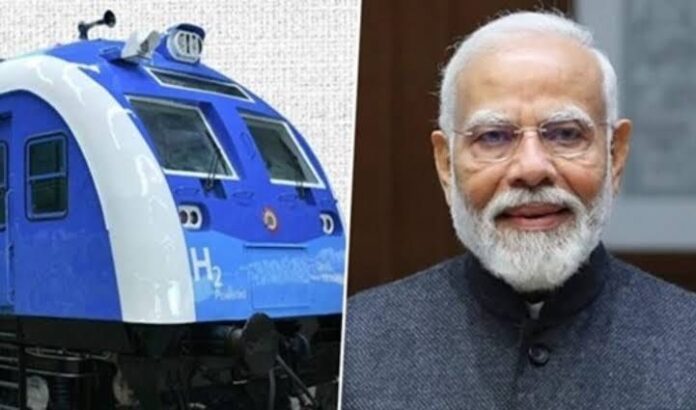
India has taken a significant step towards sustainable transportation as Prime Minister Narendra Modi flagged off the country’s first hydrogen-powered passenger train. The landmark project reflects the government’s commitment to developing cleaner mobility solutions while reducing carbon emissions across the railway network.
Manufactured by Chennai’s Integral Coach Factory (ICF), the modern 10-coach train will operate on the 89-kilometre Jind–Sonipat route in Haryana. Designed to accommodate nearly 2,600 passengers, the train can reach a maximum speed of 75 kmph and will complete two round trips daily.
Hydrogen Technology Powers India’s Green Mobility Vision
Unlike conventional diesel-powered trains, the new train uses hydrogen fuel cells combined with battery technology to generate 2,400 kW of propulsion power. The system produces electricity through a chemical reaction between hydrogen and oxygen, emitting only water vapour, making it an environmentally friendly alternative for rail transportation.
To support operations, Indian Railways has also established a dedicated hydrogen production facility at Jind station. The plant generates green hydrogen through electrolysis, ensuring a steady supply of clean fuel for the train while reducing dependence on fossil fuels.
Boosting Indian Railways’ Net-Zero Mission
The hydrogen train forms part of Indian Railways’ broader strategy to achieve net-zero carbon emissions by 2030. The project also complements the Government of India’s vision of promoting clean energy, innovation and self-reliance under the Atmanirbhar Bharat initiative.
Globally, hydrogen-powered rail technology has gained momentum after countries such as Germany introduced hydrogen passenger trains in recent years. With this launch, India joins a growing list of nations investing in next-generation railway technology aimed at reducing emissions and modernising public transport.
The successful rollout of the pilot service is expected to provide valuable operational experience and could pave the way for the introduction of additional hydrogen-powered trains across suitable railway routes in the coming years.