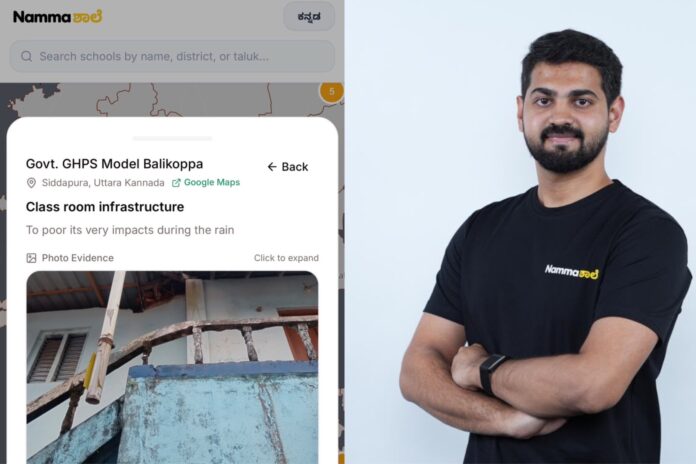
There is something unusual about NammaShale’s proposition to the Karnataka government. The platform, founded by Congress spokesperson Dhruv Jatti, says it has received 607 citizen reports concerning infrastructure and essential facilities in government schools across 26 districts. The reports cover classrooms, drinking water, toilets and sanitation, boundary walls, electricity, solar facilities and potential safety hazards. Importantly, these are citizen-reported concerns and should not automatically be treated as 607 confirmed government failures. As of September 13, NammaShale says all 607 reports remain active or pending, with 120 communicated to education authorities and no completed remediation independently verified so far.
What makes the initiative politically interesting is Jatti’s offer to provide the platform to Karnataka’s Department of School Education and Literacy without charge, provided it is formally integrated into the government system. The proposed model would give every verified complaint a digital trail—from the date it was reported and verified to the authority responsible, the action initiated, the response time and independent verification before closure. This is not necessarily an adversarial idea. In fact, a transparent system can work in the government’s favour. If officials resolve problems quickly, the public can see it; if cases remain pending, that becomes visible too. Accountability should not simply be about exposing governments—it should also allow governments to demonstrate that they are responding.
The question becomes more relevant after Education Minister Madhu Bangarappa recently met representatives of the Cockroach Janta Party following their visits to government schools and discussions around infrastructure, cleanliness and teacher availability. There is nothing wrong with the minister engaging with civic groups; governments should listen to anyone raising genuine public concerns. But it is reasonable to ask why NammaShale, which says it has gathered more than 600 reports from across Karnataka, has not received a similar opportunity to present its data and technology. That is not proof of deliberate exclusion, nor does it mean the government must adopt the platform. But at the very least, the initiative deserves to be heard and evaluated on the quality of its data, verification process and ability to improve administrative response.
The larger issue goes beyond NammaShale or any political party. Jatti occupies an unusual position: as a Congress spokesperson, he is associated with the ruling party, while as the founder of an accountability platform, he is asking that same government to make its response to school-level problems measurable and publicly trackable. That tension should not be a reason to dismiss the proposal; it should make the conversation more important. Governments should not fear credible mechanisms that reveal problems, because fixing a problem is ultimately more valuable than hiding it. If NammaShale can help Karnataka identify genuine school-level concerns, route them to the right authorities and track them until verified resolution, the government should examine the proposition seriously. Accountability should not depend on which party is in power—it should depend on whether public problems are actually being solved.