
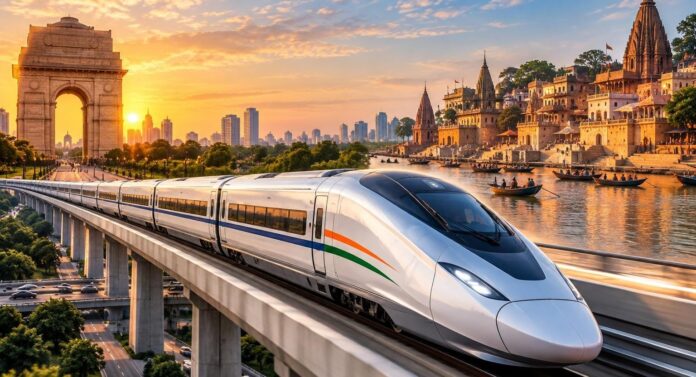
The proposed Delhi-Varanasi-Patna-Siliguri bullet train corridor has taken a major step forward. The National High Speed Rail Corporation Limited (NHSRCL) has submitted the Detailed Project Report (DPR) for the 865-km corridor.
The project aims to improve high-speed rail connectivity across several major cities in northern and eastern India. It also forms part of India’s wider plans to expand its modern rail network and reduce travel time between key destinations.
Delhi-Varanasi Bullet Train Corridor Plan
The first phase will focus on the Delhi-Varanasi section. Later phases will extend the corridor towards Patna and Siliguri.
According to the project vision, the high-speed service could reduce travel time between Delhi and Varanasi to less than four hours. This would offer a much faster alternative to existing rail services on the route.
The corridor will connect important cities and regions across northern India. Therefore, the project could improve both passenger mobility and economic links between major urban centres.
DPR Submission Marks Key Step
The submission of the DPR allows authorities to examine the project’s technical details, route, costs and construction requirements. The report will also help the government assess the next stages before construction begins.
High-speed rail projects require dedicated infrastructure, advanced signalling and specialised tracks. They also need detailed planning to ensure safe operations at very high speeds.
The 865-km corridor would become one of India’s significant proposed high-speed rail projects. Moreover, its planned extension towards Patna and Siliguri could improve connectivity across a wider region.
Faster Travel and Better Connectivity
The Delhi-Varanasi section remains the main priority under the first phase. A journey of less than four hours could make high-speed rail a strong option for business travellers, tourists and other passengers.
At the same time, the project could support economic activity around stations and connected cities. Better connectivity often helps businesses, tourism and regional development.
India has already begun developing high-speed rail infrastructure through projects such as the Mumbai-Ahmedabad corridor. The proposed Delhi-Varanasi route could further expand the country’s high-speed rail network.
The next stages will depend on government approvals, detailed planning and project implementation. Once completed, the corridor could significantly change rail travel between Delhi and eastern India.