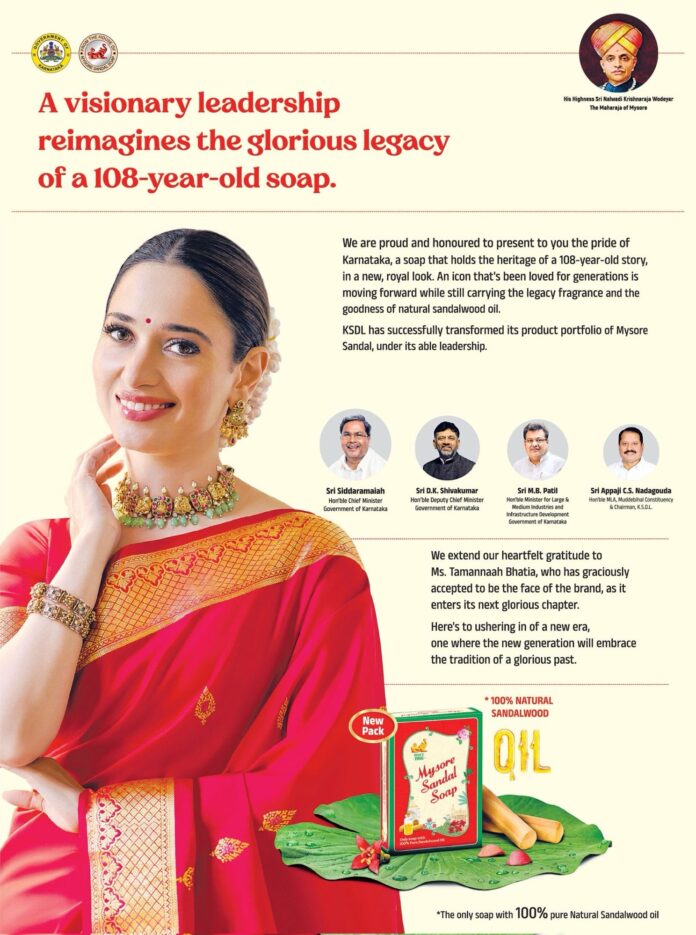
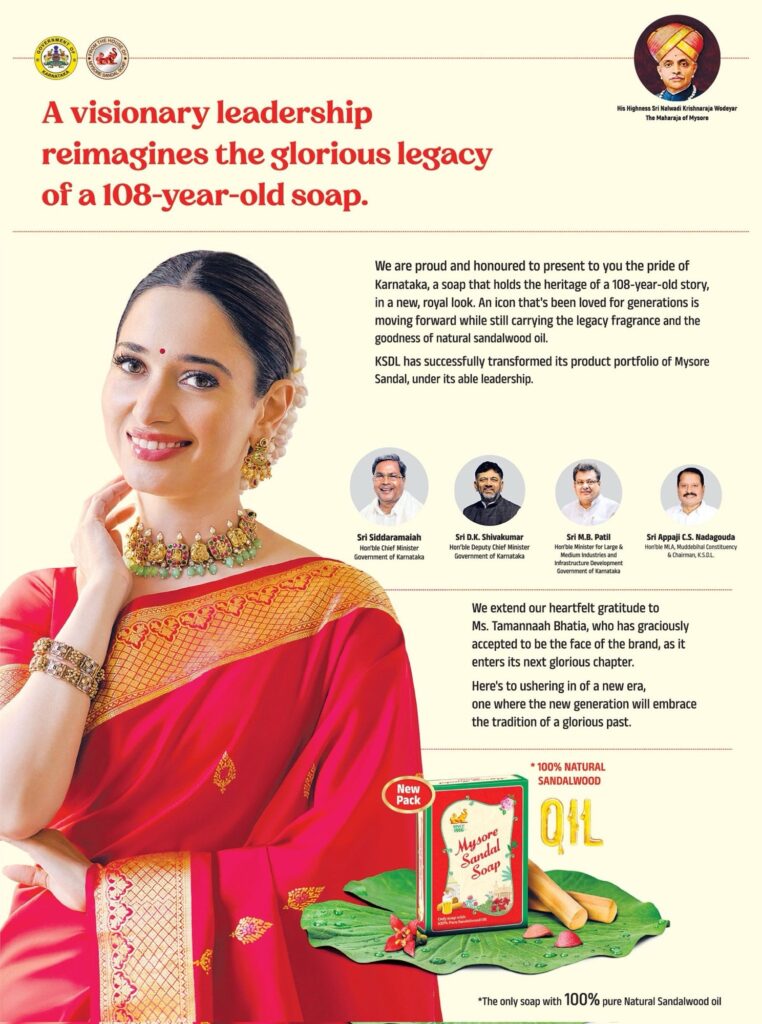
When the Karnataka government announced actress Tamannaah Bhatia as the brand ambassador for the iconic Mysore Sandal Soap, it appeared at first to be a routine marketing decision. But within hours, it snowballed into a political controversy, reopening familiar debates around regional identity, cultural ownership, and the commercialization of state legacy brands.
At the heart of the issue is Karnataka Soaps and Detergents Limited (KSDL), the state-run enterprise that manufactures Mysore Sandal Soap. Founded in the early 20th century, KSDL is not just another public sector unit. It represents Karnataka’s historical association with sandalwood, once called the “gold of Mysore.” The soap itself carries emotional value for Kannadigas, symbolizing heritage, purity, and state pride.
The Government’s Marketing Logic
From a purely business perspective, the appointment makes strategic sense.
Tamannaah is a pan-India star with visibility across Telugu, Tamil, and Hindi cinema. In an era where brands compete nationally and increasingly globally, regional icons often seek ambassadors who can transcend linguistic boundaries. Mysore Sandal Soap, though deeply rooted in Karnataka, competes in a national FMCG marketplace dominated by multinational brands with massive advertising budgets.
The state government’s logic appears straightforward:
• Expand brand recall beyond Karnataka
• Modernize the brand image
• Appeal to younger, urban consumers
• Boost exports and premium positioning
In that framework, a widely recognized face like Tamannaah becomes a marketing asset rather than a cultural statement.
The Opposition’s Argument: Regional Identity Matters
However, critics see the issue differently.
Opposition leaders questioned why a Mumbai-based actress was chosen when Karnataka has several high-profile Kannada film stars — including Rashmika Mandanna, Srinidhi Shetty, Pooja Hegde, Rukmini Vasanth, and Ramya — who could represent the brand.
Their argument rests on three pillars:
1. Cultural Ownership – Mysore Sandal Soap is not just a product; it is part of Karnataka’s identity.
2. Local Talent Promotion – A state-run enterprise, they argue, should prioritize Kannada artists.
3. Symbolic Politics – Representation in such roles sends a message about who is seen as embodying “Kannada pride.”
For critics, the decision appears disconnected from local sentiment.
Beyond the Soap: A Familiar Indian Pattern
This controversy is not new in Indian politics. Across states, government-linked brands often become arenas for identity debates. Whether it’s language in signage, cinema representation, or brand endorsements, cultural symbolism carries political weight.
In southern India especially, linguistic and regional pride are deeply embedded in public consciousness. Karnataka has previously witnessed mobilizations around Kannada language protection and state identity. In such a context, even a marketing move can be interpreted as cultural sidelining.
Commerce vs. Cultural Nationalism
The episode ultimately highlights a structural tension:
• Commercial Strategy demands scalability, cross-market appeal, and national visibility.
• Regional Politics demands symbolic alignment with local pride and representation.
If Mysore Sandal Soap aims to become a global premium brand, a pan-India ambassador fits that ambition. But if it is positioned as a heritage symbol of Karnataka, expectations shift toward local representation.
Both positions are internally coherent. The friction arises because KSDL operates at the intersection of government, commerce, and culture.
The Larger Question
Should state-owned brands behave like private corporations — focused purely on growth metrics?
Or should they also carry the responsibility of reinforcing regional identity?
The Tamannaah controversy may eventually fade. But it raises a deeper question about how India’s states balance globalization with local pride.
In a country where identity politics and brand strategy increasingly overlap, even a bar of soap can become political.