
Seven of the nine fishermen aboard the Chennai trawler Sri Sengalamman have been found dead after it capsized off Andhra Pradesh during Cyclone Murasu. Two remain missing. The tragedy has raised difficult questions about cyclone warnings, vessel tracking and coordination between state agencies.
The fishermen had left Kasimedu fishing harbour in Chennai on October 29. As weather conditions worsened, the vessel took shelter at Nizampatnam in Andhra Pradesh. It later went missing after reportedly suffering engine trouble at sea on November 3, as Cyclone Murasu crossed the Andhra coast.
What happened at sea?
According to the Indian Coast Guard’s account, the boat left Nizampatnam on the night of November 2, when the cyclone was crossing the coast. The Coast Guard said the crew may have mistaken a temporary lull in the winds as a sign that the storm had passed, without realising that the rear portion was yet to arrive.
The Coast Guard said it received the first report about the missing vessel around noon on November 3. It deployed an aircraft from Chennai and a ship from Krishnapatnam, followed by coordinated aerial and maritime searches over the next two days. The submerged vessel was sighted on November 5. By November 7, seven bodies had been recovered and the search for the remaining two fishermen was continuing.
The Coast Guard has said the boat ventured out despite repeated weather advisories. That is an important part of the official account, but it does not settle every question about the chain of events or the response after the distress call.
Warnings are only useful if the system can act on them
Reporting by The New Indian Express has highlighted conflicting accounts about where the trawler was positioned while taking shelter near Nizampatnam. A Prakasam district official told the newspaper that Andhra Pradesh authorities had not been informed about the Tamil Nadu boats in the area. A Tamil Nadu fisheries official, meanwhile, said the absence of a functioning navigation transponder made it difficult to establish the vessel’s exact location.
These are reported claims that require an official, documented reconciliation. But they point to a larger operational issue: when fishing boats from one state shelter in another state’s waters, who records their location, confirms their safe arrival and tracks their movement when a cyclone warning is issued?
Radio warnings and public advisories matter. So do reliable vessel-tracking equipment, updated harbour records and clear communication between fisheries departments, coastal police and the Coast Guard. A warning cannot protect a crew if authorities cannot establish which boats are at risk or where they are sheltering.
Beyond compensation: what must be examined?
Tamil Nadu Chief Minister C. Joseph Vijay announced ₹7 lakh for each deceased fisher’s family, with ₹2 lakh to be released immediately, and directed the government to transport the recovered bodies home. Andhra Pradesh Chief Minister N. Chandrababu Naidu also directed officials to intensify the search and coordinate with the Coast Guard and local agencies.
Relief is necessary, but it cannot replace a transparent inquiry. The authorities should establish the vessel’s precise movements, the warnings communicated to the crew, the timeline of the distress message, when each agency was alerted and what rescue resources were available. They should also clarify the condition of the boat’s navigation equipment and whether it met applicable safety requirements.
The inquiry should not begin with a predetermined conclusion that the fishermen alone were responsible, nor should it assume that agencies failed without evidence. It must reconstruct the timeline using radio logs, harbour records, weather advisories, vessel data and statements from the crew of nearby boats.
A preventable risk cannot be treated as an unavoidable loss
As of the latest reports available on November 8, two fishermen were still missing. Their families are waiting for answers, while the fishing communities of both Tamil Nadu and Andhra Pradesh face the same risks every cyclone season.
The immediate priority is to continue the search and support the families. The longer-term responsibility is to make sure that boats sheltering across state boundaries are tracked, safety equipment is functional and distress calls trigger a coordinated response without delay. The real measure of the response to this tragedy will be whether those gaps are identified and fixed before another crew is lost.
Sources
- Akashvani News: Indian Coast Guard clarification, November 7
- The New Indian Express: Questions over harbour coordination and vessel tracking, November 8
- The News Minute: Seven fishermen found dead, two missing, November 7
- Deccan Chronicle: Andhra Pradesh CM orders intensified search, November 6
- Tamil Nadu government press release, PR No. 1000, November 5
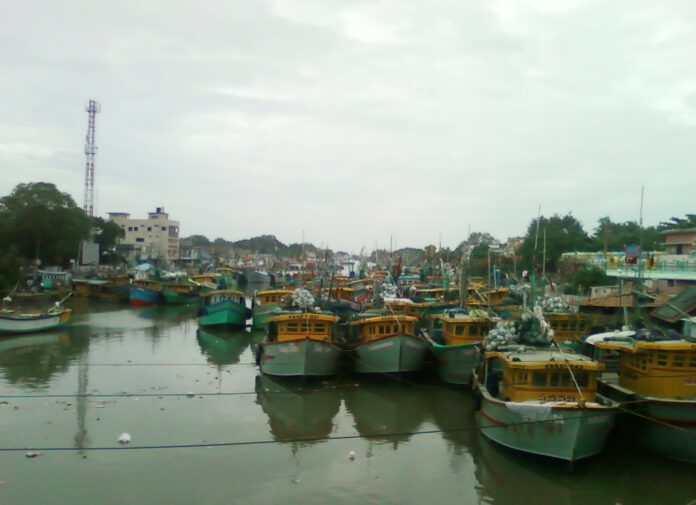
Editorial note: The featured image is an illustrative photograph of fishing boats at Kakinada harbour, not the vessel involved in this incident.