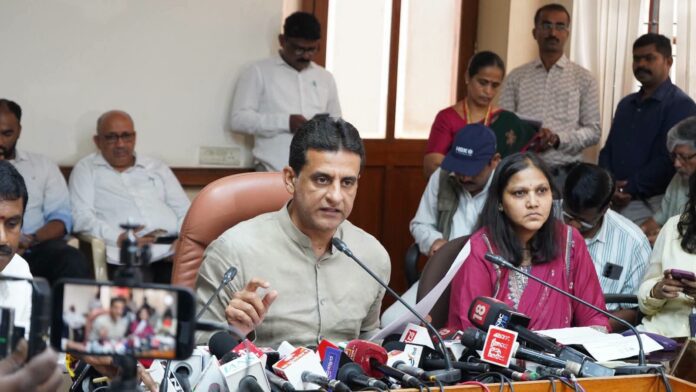
Bengaluru:Karnataka Minister Rizwan Arshad has asserted that state government stands firmly by its test report alleging ethanol being blended into petrol beyond prescribed limits and demanded Centre give clear answer instead of responding through oil marketing companies.
Addressing press conference in Bengaluru regarding state government’s tests on ethanol content in petrol and response from oil marketing companies, Arshad expressed dissatisfaction that Union Government responded through oil marketing companies instead of directly addressing serious issue.,He said tests were conducted in interest of Karnataka’s citizens and government had no personal or political interests in matter. Protecting vehicle safety and consumer rights was its primary objective. He added report released by state government triggered widespread discussion across country, including on social media.
The minister said total of 63 petrol samples collected from various fuel stations across Karnataka between September 21 and October in accordance with prescribed procedures.
During sample collection, signatures obtained from concerned officials and petrol pump representatives. Three samples prepared from each collection: one handed over to petrol pump, another retained by department, and third sent for laboratory testing. He said proper documentation maintained throughout process. Samples collected in accordance with Motor Spirit and High-Speed Diesel Control regulations. Parameters, including density, also examined during testing process, he added.
Arshad said 63 samples initially sent to oil companies, seeking their testing reports. However, companies failed to provide clear response. Consequently, samples sent to independent third-party laboratory accredited by National Accreditation Board for Testing and Calibration Laboratories (NABL).He explained NABL operates under Quality Council of India, which comes under Union Ministry of Commerce and Industry.
“If report of NABL-accredited laboratory itself is being questioned, doubts will arise about credibility of accreditation system as well. If state government’s testing is incorrect, companies must respond with scientific evidence,” he said.
The minister pointed out oil marketing companies stated in their response that ethanol blending was regulated and automated process.”If that is case, can petrol pump owners or dealers decide percentage of ethanol blended into petrol?” he questioned.He said ethanol blending takes place at six major terminals in Karnataka and remains under control of oil companies. Therefore, responsibility for excessive ethanol blending cannot simply be shifted onto petrol pump dealers. Since oil companies determine blending percentage, they must provide clear explanation, he said.
Arshad also questioned why oil companies were challenging state government’s testing methodology while their officials were conducting on-site tests at petrol pumps using hydrometers.”If tests conducted using relatively inexpensive equipment are considered valid, why is report from accredited laboratory being questioned?” he asked.
Concerns Over Impact On Vehicle Engines:The minister also raised concerns expressed by automobile manufacturers regarding quality of E20 fuel and its potential impact on vehicle engines.He said Society of Indian Automobile Manufacturers (SIAM), in letter dated July 28, 2026 to Union Petroleum Ministry, had expressed concerns about chloride and sulphur levels in E20 fuel, highlighting possibility of engine damage. He further pointed out some automobile manufacturers raised concerns regarding warranty-related issues arising from use of E20 fuel.
Referring to statement by BMW representative, Arshad questioned what impact any further increase in ethanol blending could have on two-wheelers and other vehicles commonly used by public.The minister clarified Karnataka government was not completely opposed to ethanol blending. However, it was demanding consumers be given option to choose between E10, E20 and pure petrol.
“People spend their own money to purchase fuel. How fair is it to force them to buy only one type of fuel? Consumers must have freedom to choose fuel according to their vehicle’s capacity and requirements. There should also be separate provision for pure petrol,” he said.
Arshad also referred to Bureau of Indian Standards’ IS 17021 standard and its Amendment 3, which prescribe specific testing methods to determine ethanol content in E20 fuel. He mentioned methods such as Fourier Transform Infrared Spectroscopy (FTIR), water extraction and gas chromatography.Responding to oil companies questioning state’s testing methodology, he said appropriate testing procedures must be examined scientifically and explained with technical evidence.”Simply using technical terminology cannot be reason to dismiss state government’s report,” he said.
Arshad reiterated Union Government and oil marketing companies must act responsibly and provide clear explanation regarding findings disclosed by Karnataka. He said government would not compromise on vehicle safety or consumer interests and would firmly stand by its testing report.