
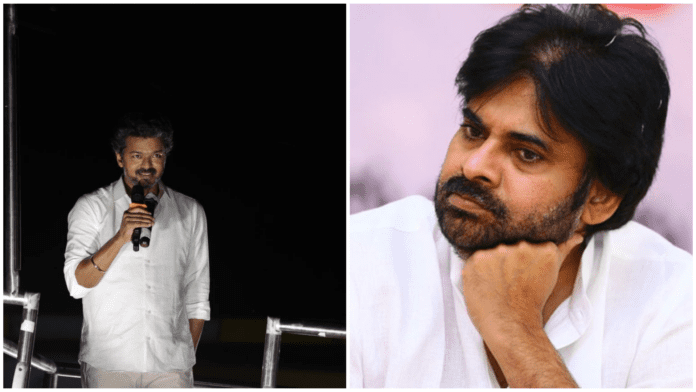
A Tale of Two Political Models in South India
In the evolving political landscape of South India, two cinematic giants Pawan Kalyan and Vijay represent two sharply contrasting political trajectories. One is an established party chief who has contested elections for years. The other had not even launched a political party when his name quietly reshaped local body elections.
The numbers tell a compelling story.
Pawan Kalyan’s Limited Local Body Impact
Pawan Kalyan, founder of the Jana Sena Party, has been politically active since 2014. Despite his popularity as a film star and fiery orator, the party’s performance in several local body elections has been modest.
In one significant local body electoral phase, candidates aligned with him managed to secure just three seats.
For a leader who commands massive crowds at public meetings and enjoys strong fan support, the translation of charisma into grassroots electoral strength has remained a challenge.
Political observers argue that:
- Crowd strength doesn’t always equal booth strength
- Alliances often overshadow independent identity
- Organizational structure matters more than emotional appeal
Vijay’s Silent Political Signal in 2021
In stark contrast stands Vijay.
In 2021, long before formally launching a political outfit, Vijay-backed candidates contested 169 local body seats in Tamil Nadu. Out of these, 129 candidates won an extraordinary strike rate in grassroots politics.
What makes this more remarkable?
- Vijay did not campaign
- He did not start a political party yet
- He did not send film celebrities to canvass
- There were no massive roadshows
- No official political symbol
The campaign strategy was minimalistic:
Candidates simply used Vijay’s image and support identity.
And it worked.
The Power of Symbolism vs The Structure of Politics
This contrast raises critical questions in South Indian politics:
| Factor | Pawan Kalyan Model | Vijay Model (2021) |
|---|---|---|
| Formal Political Party | Yes | No (at that time) |
| Active Campaigning | Yes | No |
| Star Campaigners | Yes | No |
| Seats Won | 3 | 129 (Just Vijay’s Face) |
| Strategy | Direct Political Mobilization | Silent Symbolic Mobilization |
The difference reflects two political philosophies:
- One depends on active participation and alliance arithmetic
- The other relied purely on brand recall and emotional connect
Why Vijay’s 2021 Result Was Politically Significant
Tamil Nadu politics has historically been driven by structured party systems like the Dravida Munnetra Kazhagam (DMK) and All India Anna Dravida Munnetra Kazhagam (AIADMK). For independent candidates associated informally with an actor without party machinery to win 129 seats was unprecedented.
It signaled three key shifts:
- Fan clubs evolving into micro-political units
- Cinema influence translating directly into local governance
- A possible disruption of traditional Dravidian party dominance
The 2021 Local Body Elections: A Political Message?
The 2021 Tamil Nadu local body elections became more than just ward-level contests. They became a political experiment.
Vijay’s influence demonstrated:
- A ready grassroots network
- Strong booth-level mobilization by fan associations
- Organic vote consolidation without formal structure
For political strategists, it was a case study in brand-driven politics.
Celebrity Politics in South India: A New Phase?
South India has seen film icons transition into political leadership before. But the difference here lies in timing and method.
- Pawan Kalyan built a party first and then tested strength.
- Vijay tested strength informally before launching political ambitions.
This reversal of sequence may define the future of celebrity-led politics.
While Pawan Kalyan remains an active political force in Andhra Pradesh, Vijay’s 2021 local body impact in Tamil Nadu highlighted something unique influence without formal power can sometimes be more powerful than formal structures without deep grassroots consolidation.
The coming years will determine whether symbolic momentum transforms into sustained political dominance.