
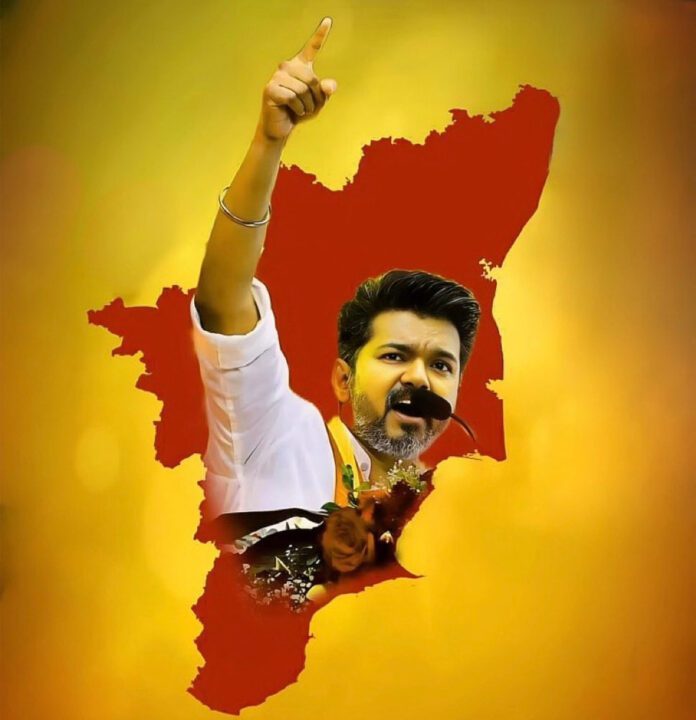
The Rise of Vijay in Tamil Nadu Politics
Tamil superstar Vijay’s emergence as the chief ministerial candidate of Tamilaga Vettri Kazhagam (TVK) marks a significant political development in Tamil Nadu ahead of the 2026 assembly elections. With an 18% popularity rating as a potential chief minister candidate, he trails only behind incumbent M.K. Stalin’s 27%. In just two years since founding his party, Vijay has positioned himself as a formidable political force.
His declaration of candidacy in July 2025 was a decisive moment in Tamil Nadu politics. It signaled his party’s ambitious goal to replicate the MGR phenomenon of 1977. Back then, the matinee idol’s AIADMK won 144 of 200 contested seats on its debut. Vijay confidently predicts that “2026 will be as significant as 1967 and 1977.” He believes that TVK can achieve what new parties accomplished in those watershed elections.
Strategic Political Positioning and Ideology
The Left-of-Centre Approach
TVK has positioned itself as a left-of-centre party. Its ideological foundations are rooted in Ambedkarism, Periyarism, and Marxism. Vijay has strategically chosen five reformers as his party’s guiding spirits: B.R. Ambedkar, Periyar E.V. Ramasamy, K. Kamaraj, Velu Nachiyar, and Anjalai Ammal. Notably, he has distanced himself from Periyar’s atheism while embracing his principles of social justice, rationalism, and women’s empowerment.
This ideological positioning allows TVK to appeal to both Dravidian nationalism and Tamil nationalism, which Vijay describes as the “two eyes of this soil.” The party’s approach represents a careful balance between progressive values and cultural sensitivities. This strategy could attract voters who feel alienated by the perceived extremes of other parties.
The Dual Enemy Strategy
Vijay has identified a dual enemy framework that defines TVK’s political strategy:
- Ideological Enemy: The BJP, representing divisive communal politics.
- Political Enemy: The DMK, accused of corrupt family politics under the guise of Dravidian ideology.
This positioning allows TVK to differentiate itself from both major political forces while appealing to anti-establishment sentiment. Vijay’s criticism of the BJP’s “divisive politics” based on religion and caste resonates with Tamil Nadu’s secular political traditions. His attacks on DMK’s “corrupt family politics” tap into anti-incumbency feelings.
Organizational Strength and Grassroots Foundation
Fan Club Network as Political Infrastructure
TVK’s organizational foundation rests on Vijay’s extensive fan club network of approximately 85,000 clubs across Tamil Nadu. Each club has at least 25 members. This network, previously organized under Vijay Makkal Iyakkam, has transformed into a political cadre forming TVK’s grassroots structure. The party’s MYTVK mobile application aims to coordinate booth-level operations and membership drives, targeting a five crore supporter base.
The membership drive has been digitally linked to Voter IDs. Within hours of launch, enrollment reached several lakhs, primarily among youth, women, and household heads. This technological approach to organization reflects Vijay’s understanding of modern political mobilization techniques.
Electoral Strategy and Campaign Approach
TVK has announced its intention to contest all 234 assembly seats independently. Vijay has ruled out alliances with either DMK or BJP. His declaration that “there will be no compromise in our political battle” and his promise to “share power with those who come with us” indicates confidence in achieving majority status while keeping alliance options open with smaller parties.
The party’s campaign strategy emphasizes door-to-door and street-to-street campaigning to connect directly with voters. This grassroots approach, combined with Vijay’s massive star appeal, aims to create what he calls a “silent revolution” to capture power.
Challenges and Opportunities in the Tamil Political Matrix
The Caste Dynamics Challenge
Tamil Nadu’s political landscape is heavily influenced by caste demographics. Major communities include Vanniyars (12-15%), Dalits (19-21%), Thevars, Gounders, and Nadars, all holding significant electoral sway. TVK’s success will depend on its ability to transcend traditional caste loyalties through its secular social justice platform.
The party’s emphasis on “equality at birth” as a core ideology and its anti-caste stance could appeal to progressive voters. However, it must navigate the complex caste arithmetic that has historically determined electoral outcomes in Tamil Nadu.
The Cinema-Politics Nexus
Vijay’s political entry continues Tamil Nadu’s unique tradition of cinema-politics intersection. This follows the legacy of MGR, Jayalalithaa, and other film personalities who successfully transitioned to politics. However, unlike his predecessors, who gradually built political bases over decades, Vijay faces the challenge of achieving immediate electoral success in his first attempt.
Historical precedent shows that stardom alone doesn’t guarantee political success. While MGR and Jayalalithaa succeeded through sustained political engagement and welfare policies, others like Vijayakanth achieved limited success despite significant fan followings.
Electoral Prospects and Impact Assessment
Current Polling Dynamics
Recent surveys indicate a competitive four-way contest emerging in Tamil Nadu:
- DMK Alliance: Led by M.K. Stalin with 27% CM preference.
- AIADMK-BJP Alliance: Edappadi Palaniswami with 10% preference.
- TVK: Vijay with 18% preference as CM candidate.
- Other Parties: Including Seeman’s NTK and smaller outfits.
Stalin’s personal popularity (22% very satisfied with his performance) gives DMK an advantage. However, Vijay’s 18% preference rating demonstrates significant potential for political disruption.
The X-Factor Potential
Political analysts describe Vijay as the “X-factor” in the 2026 elections. His presence has generated unprecedented public interest in state politics. His entry has forced both DMK and AIADMK to launch early campaigns, indicating their recognition of his disruptive potential.
The question remains: can Vijay convert star power into political power effectively? His confident prediction of achieving a “landslide victory” and “clean sweep” suggests supreme confidence. However, electoral success requires more than popularity—it demands effective organization, coherent policies, and strategic alliances.
Policy Framework and Governance Vision
Progressive Social Agenda
TVK’s policy positions reflect its left-of-centre ideology:
- Opposition to NEET examination as discriminatory against rural students.
- Maintenance of the two-language policy (Tamil and English).
- Women’s safety as a key priority.
- Educational reform with a focus on accessibility.
- Anti-corruption measures and transparent governance.
Constitutional and Federal Issues
The party has taken strong positions on national issues:
- Opposition to “One Nation, One Election” as anti-democratic.
- Rejection of Hindi imposition and promotion of Sanskrit.
- Criticism of the Waqf Amendment Bill as communally divisive.
- Support for Tamil Nadu’s autonomy in educational and cultural matters.
The Road to 2026: Critical Success Factors
Organizational Scaling
TVK’s success depends on converting fan enthusiasm into electoral machinery. The party must demonstrate its ability to field credible candidates across all 234 constituencies. It should maintain message discipline and avoid the personality cult trap that has limited other regional parties.
Alliance Calculations
While Vijay has ruled out major alliances, strategic partnerships with smaller parties representing specific communities could enhance TVK’s electoral prospects. This can be done without compromising its independent image. The party’s stance on power-sharing suggests openness to post-election coalitions if needed.
Policy Differentiation
TVK must articulate clear governance alternatives beyond opposition to existing parties. The party’s challenge lies in translating ideological positions into concrete policy proposals. These should address Tamil Nadu’s development challenges, including industrialization, employment generation, and environmental sustainability.
The Vijay Phenomenon’s Electoral Test
Vijay represents a unique political phenomenon in Tamil Nadu. He is a mass entertainer attempting to replicate the MGR model in contemporary democratic conditions. His 18% popularity rating and ability to generate unprecedented political discourse demonstrate significant potential for electoral impact.
However, success in 2026 will require more than star power. The party must prove its organizational depth, policy coherence, and ability to translate popularity into votes across diverse constituencies. With Tamil Nadu’s history of dramatic political shifts, Vijay’s political journey represents another potential watershed moment in the state’s electoral evolution.
The 2026 elections will ultimately test whether the cinema-politics nexus remains viable in modern Tamil Nadu. Will governance experience and established party machinery prevail over star charisma and anti-establishment rhetoric? For Tamil Nadu’s political future, TVK’s performance could determine whether the state witnesses another transformative moment comparable to the historic elections of 1967 and 1977.