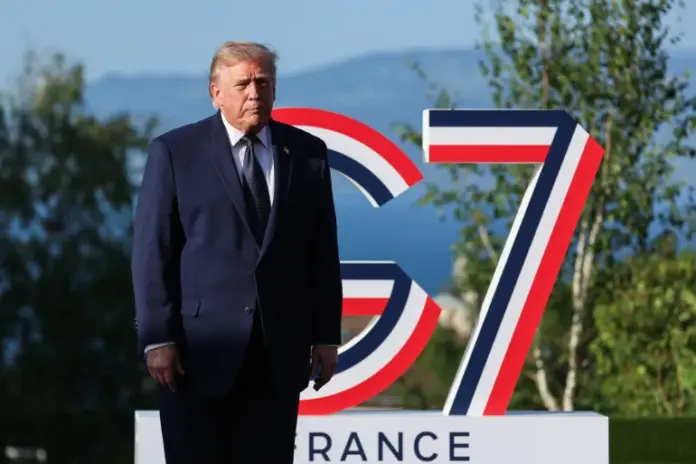
Evian-les-Bains, France: In a significant statement during a bilateral meeting on the sidelines of the G7 Summit, U.S. President Donald Trump said that the United States would defend India if it came under attack while Prime Minister Narendra Modi remained in office, despite the absence of any formal mutual defense treaty between the two nations.
Speaking to reporters after meeting Prime Minister Modi, Trump emphasized the strong personal relationship between the two leaders, noting that it was their first face-to-face interaction in nearly 16 months.
“If India were attacked while Modi is leading, we would be there for India,” Trump said, underlining what he described as the deep trust and understanding between Washington and New Delhi.
The remarks come at a time when India and the United States are expanding their strategic partnership across defense, technology, and regional security. The two countries have significantly increased military cooperation in recent years through joint exercises, intelligence-sharing mechanisms, and major defense procurements.
India is currently acquiring advanced military platforms from the United States, including Apache attack helicopters and MQ-9B Predator drones, aimed at enhancing its surveillance and combat capabilities. The growing defense relationship has also been reinforced through agreements focused on logistics, communications, and technology cooperation.
Trump’s comments are also being viewed in the broader context of the Quad grouping, which includes India, the United States, Japan, and Australia. The alliance has increasingly focused on maintaining a free and open Indo-Pacific region amid concerns over China’s expanding military and strategic influence.
However, analysts point out that no formal defense pact exists between India and the United States. Unlike NATO allies, neither country is legally obligated to come to the other’s defense in the event of an armed conflict.
Despite occasional tensions over tariffs, trade policies, and diplomatic disagreements, the strategic relationship between New Delhi and Washington has continued to deepen under successive governments in both countries.
Observers say Trump’s remarks reflect his long-standing preference for personality-driven diplomacy, often placing significant emphasis on relationships between leaders. While the statement does not represent a formal policy commitment, it signals the importance Washington places on its partnership with India and highlights the growing convergence of interests between the world’s two largest democracies.
As geopolitical competition intensifies across the Indo-Pacific, Trump’s comments are likely to fuel discussions about the future trajectory of India-U.S. strategic cooperation and the role both nations could play in shaping regional security in the years ahead.