
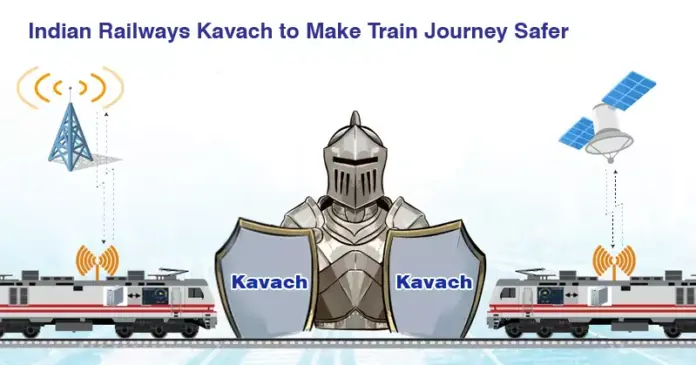
New Delhi, June 15, 2026 — Indian Railways has approved new projects worth ₹341 crore to expand the Kavach Railway Safety System across key routes in northern and western India.
The approvals include a ₹201 crore project for the Ambala Division of Northern Railway and a ₹140 crore project for the Ahmedabad Division of Western Railway.
Kavach Railway Safety System to Cover Over 1,400 Route Kilometres
The Ambala Division project will cover 811 route kilometres across important rail corridors connecting Haryana, Punjab, and Himachal Pradesh.
The approved sections include:
- Ambala Cantonment–Ludhiana
- Kalka–Chandigarh–New Morinda–Sahnewal
- Sirhind–Daulatpur Chowk
- Rajpura–Bathinda–Shri Ganganagar
- Ludhiana–Dhuri–Jakhal
Meanwhile, the Ahmedabad Division project will bring Kavach Version 4.0 to 598 route kilometres covering 48 block sections across Gujarat.
What Is Kavach?
The Kavach Railway Safety System is an indigenously developed Automatic Train Protection (ATP) technology.
The system helps prevent Signal Passing at Danger (SPAD), automatically applies brakes during unsafe situations, controls train speed, and reduces the risk of collisions.
As a result, Kavach improves railway safety and enhances operational efficiency.
Ahmedabad Division Nears Full Kavach Coverage
Indian Railways had already sanctioned Kavach work on around 702 route kilometres in the Ahmedabad Division.
With the latest approval, the remaining sections will also come under the protection system.
Therefore, the division is moving closer to complete Kavach coverage across its network.
Railways Pushes Safety Modernisation
Indian Railways continues to expand the Kavach Railway Safety System as part of its broader safety and modernization programme.
Officials say the technology will strengthen passenger safety, improve reliability, and support growing traffic on high-density and strategically important routes.
Furthermore, the LTE-based communication backbone will improve real-time train protection capabilities across the network.